
Every pursuit makes the next one smarter.
Decide, strengthen, prove and stress-test each proposal with evidence you can trace, and keep what you learned for the next one.
Four experiences. One system of intelligence.
Keep your workflow. Upgrade your intelligence. RiseLab sits above or beside the tools your capture team already uses, and what accumulates is a provenance-backed record of how your company competes, not another folder of proposals.
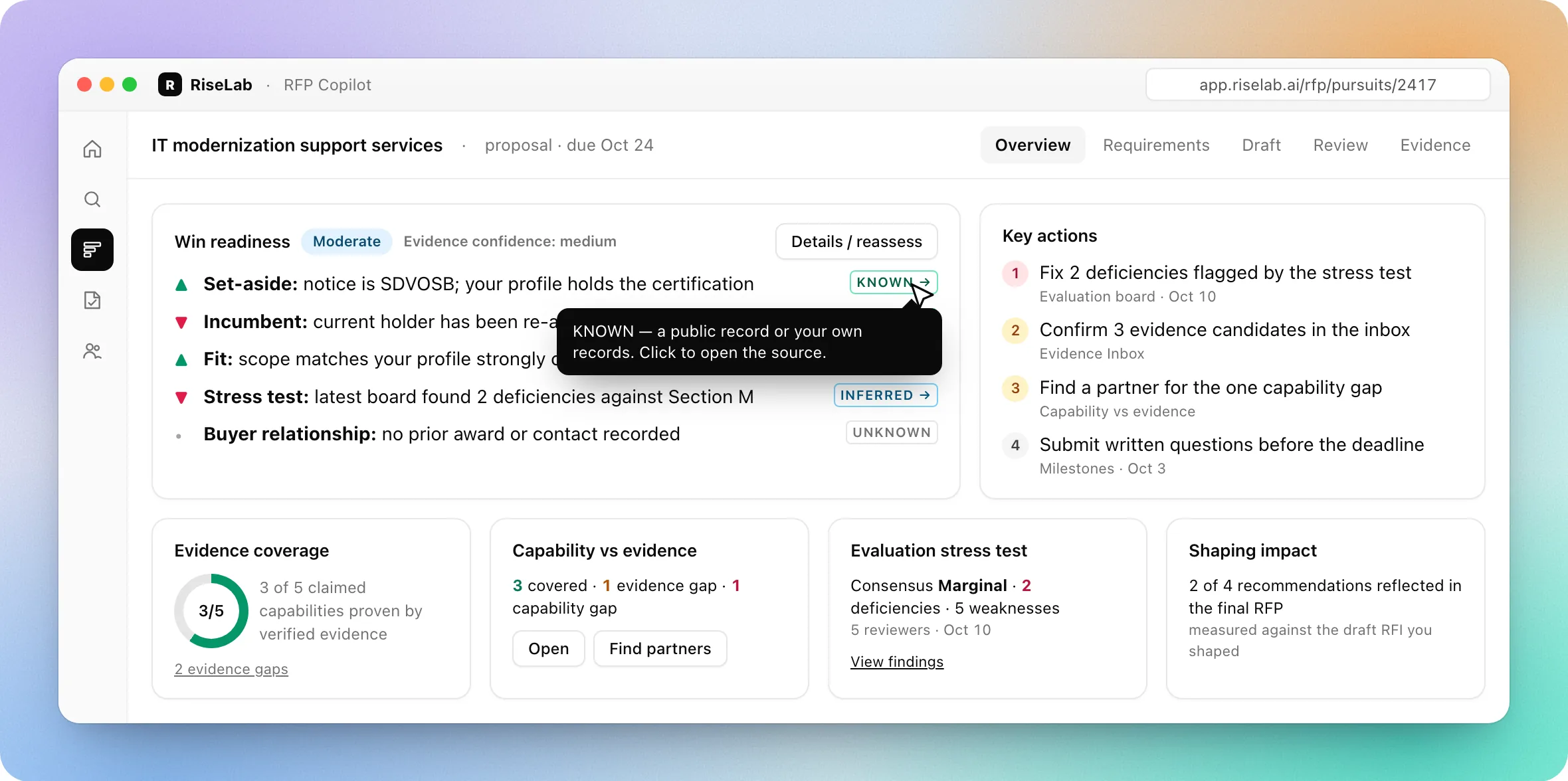
Should we pursue this, and what does the evidence say?
Win readiness as a band with named drivers, never a percentage — and an evidence-confidence line that says how much RiseLab actually knows about the pursuit.
- •Every driver tagged KNOWN, INFERRED or UNKNOWN, each one a click from its source
- •Favors pursuit / threatens pursuit / unknown, from public award records and your own history
- •A win plan across the pipeline: pursue, shape, team, no-bid, within your people and budget
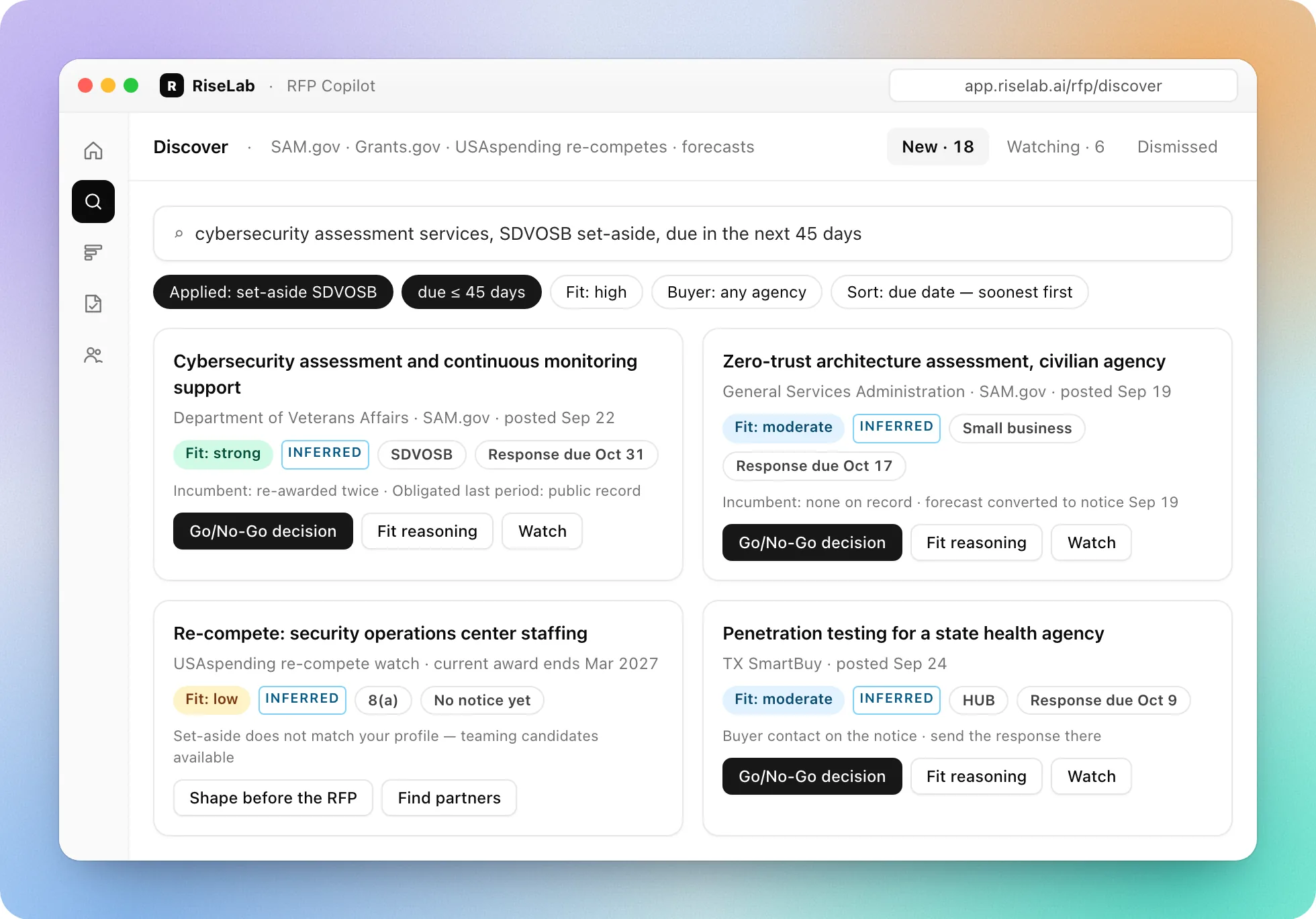
What must we resolve to be credible?
Capability gaps and evidence gaps are different problems. One needs a partner; the other needs documentation. RiseLab tells you which is which.
- •Per capability the solicitation demands: do we claim it, can we prove it
- •Teaming candidates from public award data — who already delivers to this buyer, who holds the set-aside
- •Shaping before the RFP exists, and later, how much of what you recommended the final solicitation reflected
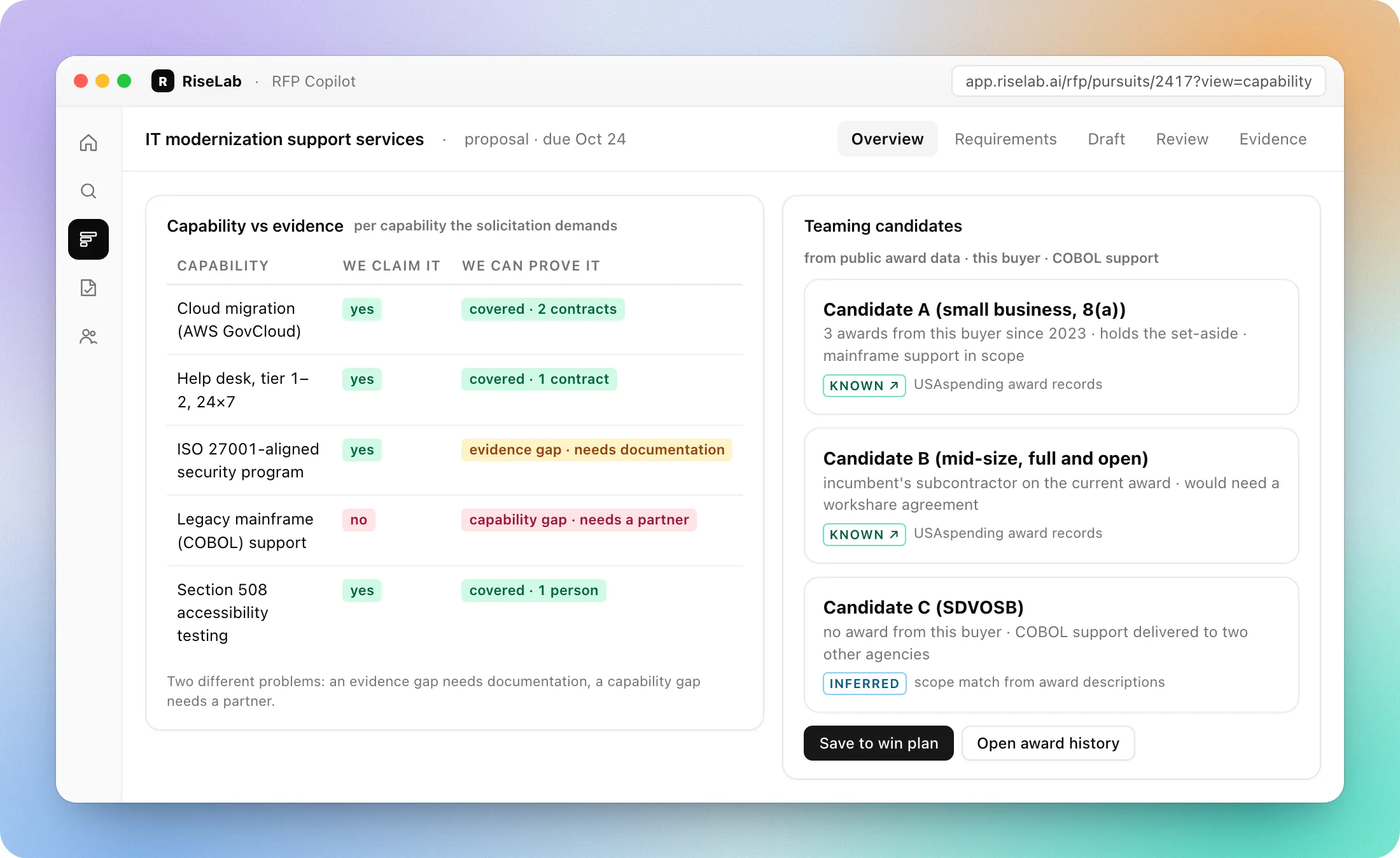
Build every claim from traceable corporate evidence.
An evidence graph extracted from your own material — contracts, people, certifications, results — where nothing becomes corporate truth until you confirm it.
- •An Evidence Inbox: candidates with their issues, confirmed by a human or established by a public record
- •Every company-fact claim in a draft checked against verified evidence; unsupported figures get a fix, not a rewrite
- •Corporate evidence health: which capabilities in your pipeline you can substantiate, and the highest-value gaps
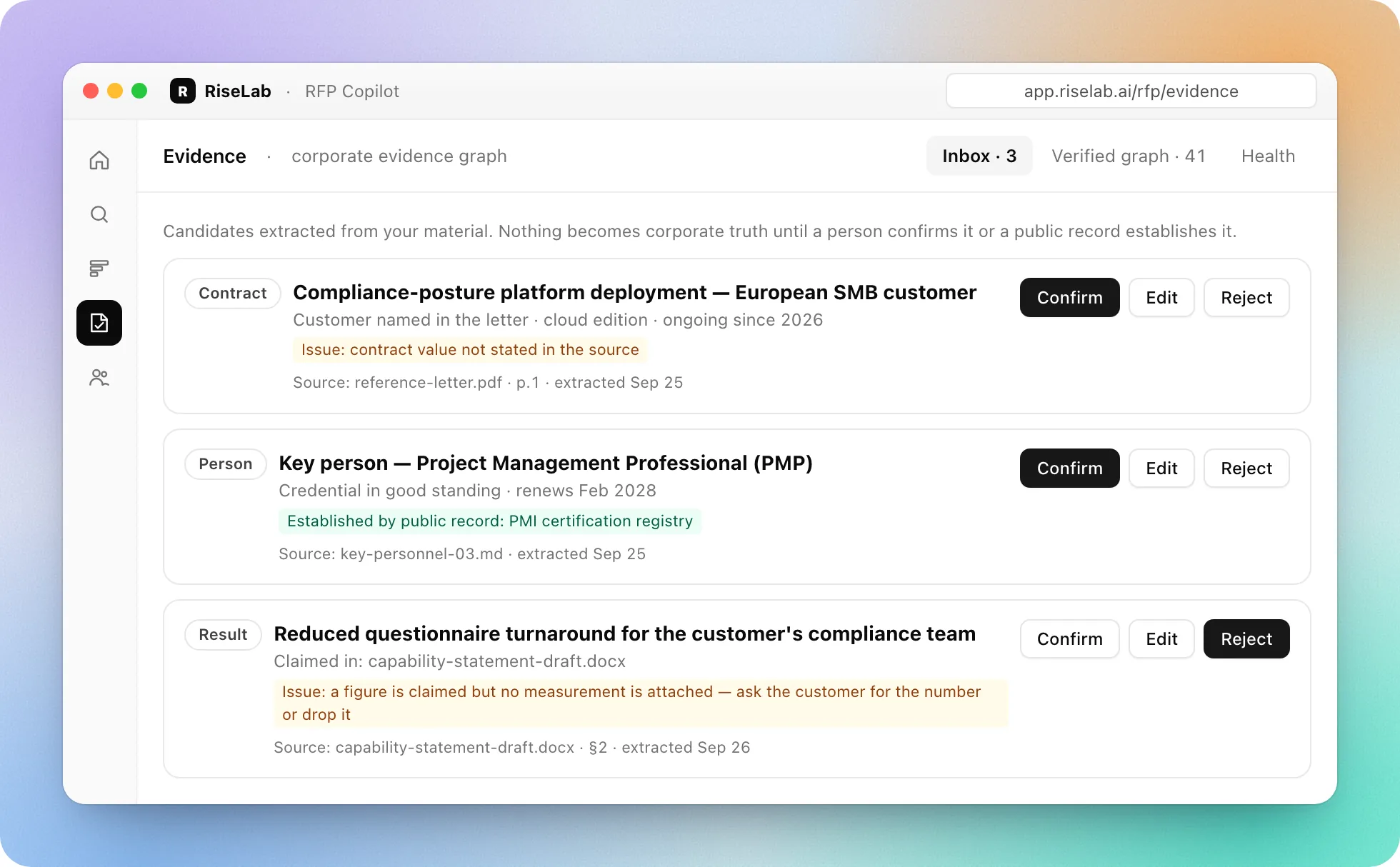
Evaluate the proposal against the government’s actual criteria first.
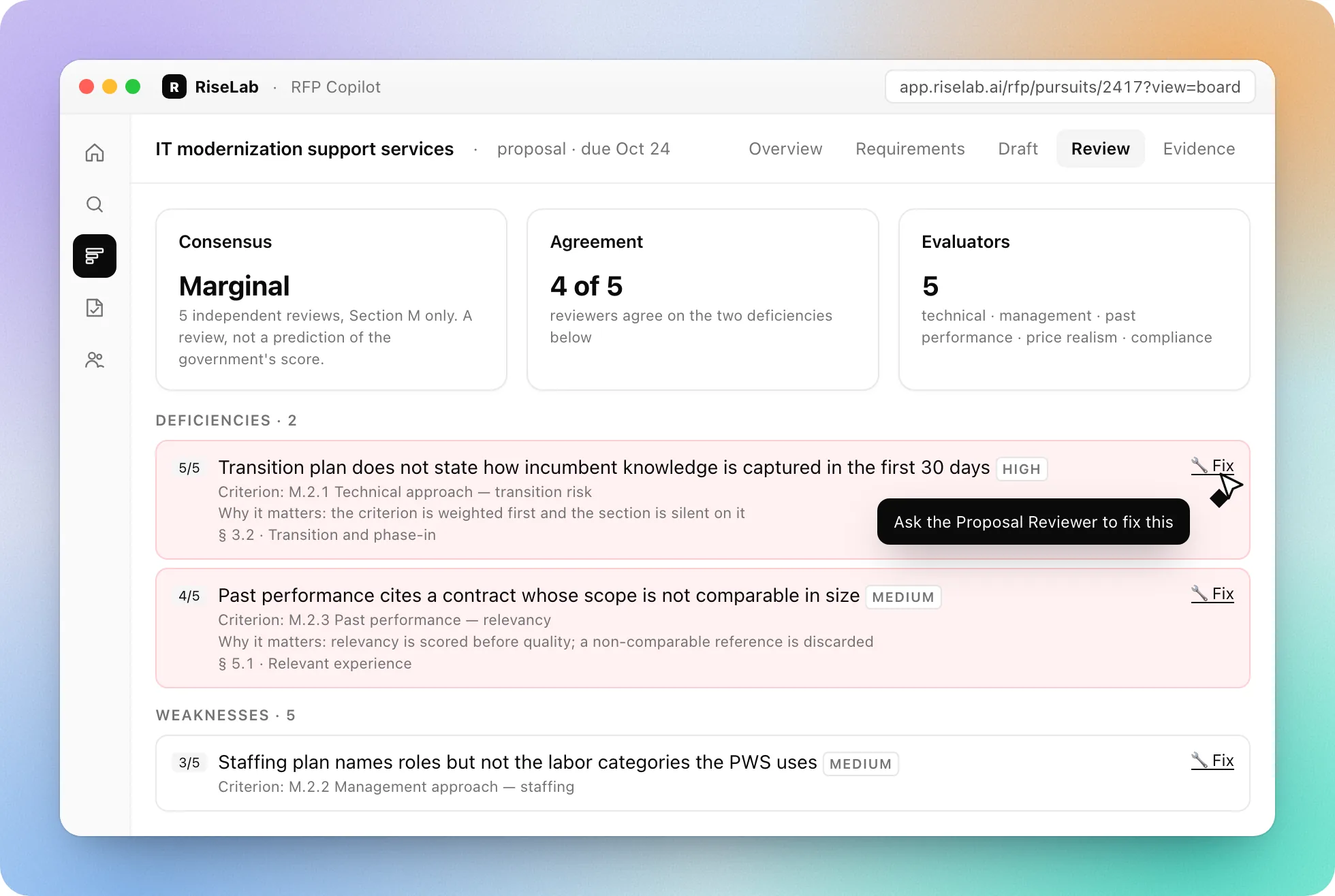
Five independent reviews grounded strictly in Section M surface plausible weaknesses, deficiencies and ambiguities — with the criterion, the confidence and why it matters. Not a prediction of the government’s score.
- •Consensus and disagreement across reviewers; each deficiency has a Fix action into the reviewer chat
- •Predicted concerns are recorded at submission and graded against the real debrief
- •Underneath everything, Learn: outcomes and debriefs close the loop, inside your organization only
What accumulates — and why it cannot be copied
A feature can be copied. What cannot be recreated is the record RiseLab keeps for your company: what you could prove, what each pursuit required, what you knew, inferred and did not know when you decided, what the stress test flagged, what evaluators actually questioned, and why you won or lost. Every pursuit adds structured evidence to that record. We do not claim the AI “learns how to win”; we claim exactly what is stored, with provenance.
One principle governs every screen, prompt and number: RiseLab will never present an inference with more confidence than the evidence deserves. Every driver, finding and recommendation is tagged KNOWN, INFERRED or UNKNOWN, and an unknown stays unknown.
One workflow, end to end
Most teams stitch this together from a tracker, a folder of old proposals, and late nights. RFP Copilot runs it as one pipeline.
Every opportunity, one intake
Continuous scanning across SAM.gov, Grants.gov, Govly, TX SmartBuy, World Bank, and USAspending re-competes. Fit scoring against your company profile, deep-score analysis, and a Go/No-Go you can defend.
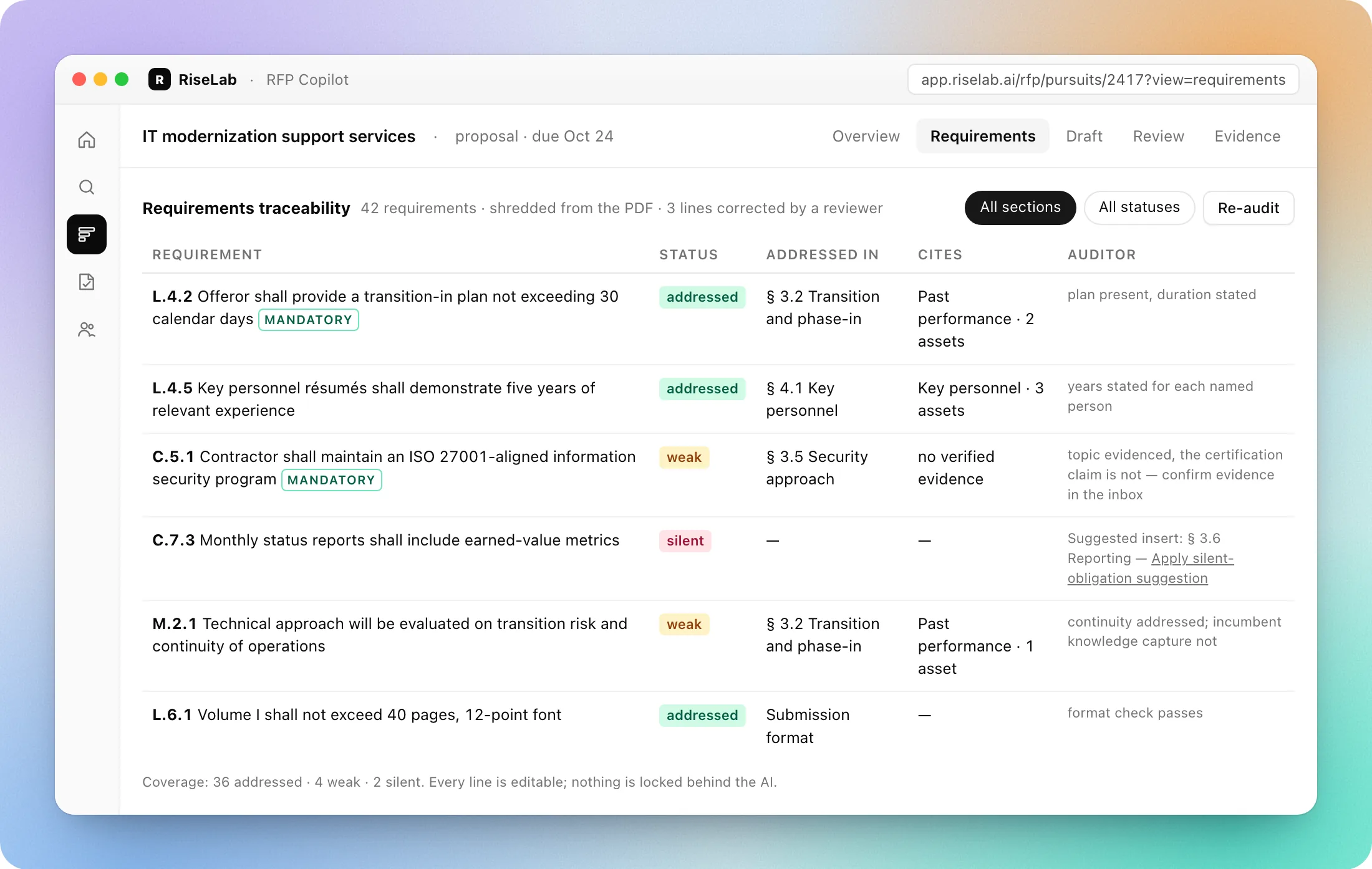
RFP in, compliance matrix out
Upload the PDF or DOCX and the shredder extracts a structured requirement set in about thirty seconds — mandatory flags, eval criteria, submission format, attachments. Reviewers correct any line inline; nothing is locked behind the AI.
An agent team writes the response
Responder drafts one section per requirement, grounded against your content library. Assembler composes the document and runs a grounding audit that flags any claim without evidence. You choose which assets each proposal may cite.
One consolidated human review
Coverage stats (requirements answered, citations used, grounding score), a chat panel to interrogate the draft, and two buttons that mean what they say: approve into submission prep, or send back for rework with your feedback.
The loop does not end at send
Submission stamps who sent what to whom. Follow-up milestones appear automatically — receipt confirmation, status inquiry, FAR 15.505/15.506 debrief windows — with an RE-threaded composer prefilled with the original recipients.
Outcomes feed the next pursuit
Win/loss tracking, debrief extraction, a prediction ledger that grades what the stress test flagged against what evaluators actually said, and award intelligence that watches for results after you submit.
Built for capture teams, not demos
Market intelligence
USAspending awardee profiles, buyer-agency dossiers with mission and budget, and award portfolios you can save straight into your evidence library — public records, honestly labeled.
Content library that builds itself
Upload past performance and boilerplate, import your own won federal contracts by UEI, or pull documents in from Google Drive and SharePoint. Every asset carries a review clock.
Grounding you can gate on
An org-tunable policy decides how much of a draft must cite real evidence before it can be approved. Fabrication is flagged, not shipped.
Your team, your agents
Add reviewers with workload visibility, place custom agents before or after the drafting wave, and ask the workspace assistant questions like "which proposals are due next week?" — answered from live data.
Native desktop app
The full pursuit workflow — pipeline, shredding, review, follow-ups — in a signed, notarized macOS app with the same account.
Exports that match the ask
Section-structured drafts, capability statements, and final versions ready for human polish. Nothing is transmitted to any agency by the platform — you stay in control of send.
What we won't do
AI proposal tools live or die on trust. Here is where ours draws the line.
AI drafts. Humans submit.
Every proposal passes a human review gate before submission prep, and the platform never transmits anything to an agency. The audit trail records who approved what.
No invented past performance
The grounding audit scores every claim against your actual content library. Drafts that fall below your grounding policy cannot be approved until a human addresses the gap.
Never more confidence than the evidence deserves
No point-estimate win probability, no price-to-win curve, no "+N%" claims. Readiness is a band with tagged drivers; the stress test is a review, not a forecast; shaping impact is measured, never asserted. Unknowns stay unknown.
Winning proposals are not for sale
Competitors’ winning proposal documents are barred from disclosure by law (41 U.S.C. § 4702). Tools that imply otherwise are selling you something else. We give you the legal signal instead: award histories, buyer budgets, incumbent patterns.
Pricing
Self-serve tiers. Change or cancel from inside the product — no procurement call required.
Pursuit
- SAM.gov + Grants.gov discovery
- Shredder + compliance matrix
- Agent-team drafting with grounding audit
- Desktop app included
Win
- 3 seats · 10 active pursuits
- SAM.gov + Grants.gov discovery
- Shredder + compliance matrix
- Agent-team drafting with grounding audit
- Desktop app included
Powered by the RiseLab Platform
The same multi-agent orchestration, RBAC, and audit infrastructure that runs our other vertical solutions — not a wrapper around a single prompt.
Multi-agent orchestration
Shredder, Responder, Assembler, and Aggregator run as a real team with pre/post placement for your own custom agents.
Bring your own model
Cloud API models, fine-tuned models, or endpoints deployed on the platform — switchable per conversation from the chat composer.
Audit everything
Uploads, edits, approvals, submissions, and follow-ups are logged. Compliance can reconstruct the chain of custody for any document.
Book 15 minutes on your own pursuit
Pick a time now. Bring an RFP you are actually pursuing and your existing materials; we will walk it through Decide, Strengthen, Prove and Stress test on your document.
Prefer email? Send us the solicitation and we will propose a time.
See it on one live pursuit
Bring an RFP you're actually pursuing and your existing materials. In one session you will see the reasons it fits and what is known, inferred and unknown; your material gaps and which are capability versus evidence; which claims you can substantiate and their provenance; and how the draft holds up against Section M. Then ask your current system the same questions.